Internal products for Marketing & Communication
Two products designed and built end to end for an 800-person global tech company: KUDOS Generator, an AI assistant that turns generic shoutouts into real recognition, and the World Cup Pool, a multi-language prediction game for the FIFA World Cup 2026. Both built to remove the friction that was killing internal engagement.
I led both products end to end: strategy, UX, UI, and the full build. From the relaunch decks for KUDOS to deploying the World Cup Pool on Vercel, this was a one-designer-one-builder operation.
10Pearls is a global tech company with more than 800 people across 5+ countries. Its Marketing & Communication team isn't just designing posts and onboarding decks. It's the team in charge of how the company actually feels to work at. When they came to me, two cultural rituals needed help: peer recognition, which had become a chore people skipped, and company-wide events, which kept losing energy edition after edition. We didn't relaunch programs. We built products.
Recognition was treated as a task: late, generic, low emotional impact. Company-wide moments (World Cup, year-end, etc.) lost engagement year over year because participation required too many steps. The diagnosis wasn't the people, it was the design of the rituals. Both needed to stop being programs and start being products.
Two products with the same philosophy: make the right thing the easy thing. KUDOS Generator removed the blank-page problem of writing recognition: pick who, what they did, the tone, and AI drafts a specific, well-written kudo in seconds. World Cup Pool turned the World Cup into the company's group chat: multilingual auth, predictions, leaderboard, all built to give every employee a reason to show up daily for a month and a half.
A global digital product company headquartered in the US, with engineering and design hubs across Latin America, Asia and Europe.
10Pearls builds digital products for enterprise clients across healthcare, finance, education and consumer tech. With distributed teams across Latin America, Asia and the US, internal culture isn't a side project, it's what holds the company together across timezones.
The Marketing & Communication function owns the rituals that make this distributed company feel like one. When the existing tools weren't doing the job, the team decided to design and build their own instead of buying off-the-shelf.
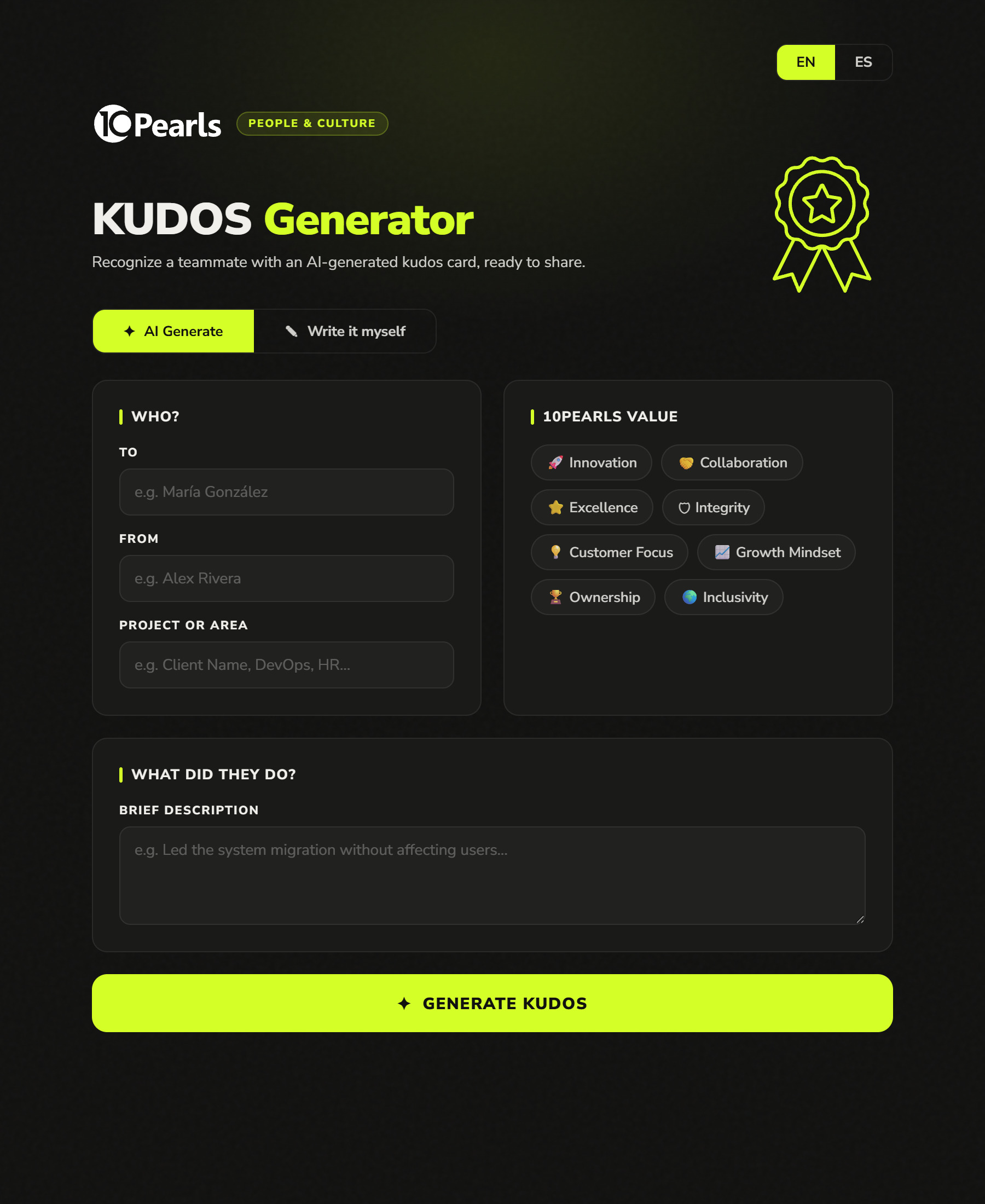
An AI-powered recognition tool built for 10Pearls' People & Culture team, enabling employees across LATAM to send meaningful kudos to their teammates in seconds.
Existing recognition processes were manual, inconsistent, and rarely used. The goal was to remove friction entirely: no lengthy forms, no blank-page anxiety.
An AI-powered generator for those who want a head start, and a manual writing mode for those who prefer full control. Same destination, two paths.
Both modes produce a card in Classic or Fun styles, ready to copy and share with teammates. The recognition shows up looking like recognition, not like a form submission.
Backed by a Groq LLM through a Cloudflare Worker proxy. The setup keeps API keys out of the client without needing a full backend, fast responses, low cost.
Accessible from a simple URL, no install required. Designed to fit into the team's existing workflow with zero onboarding. Open it and use it.
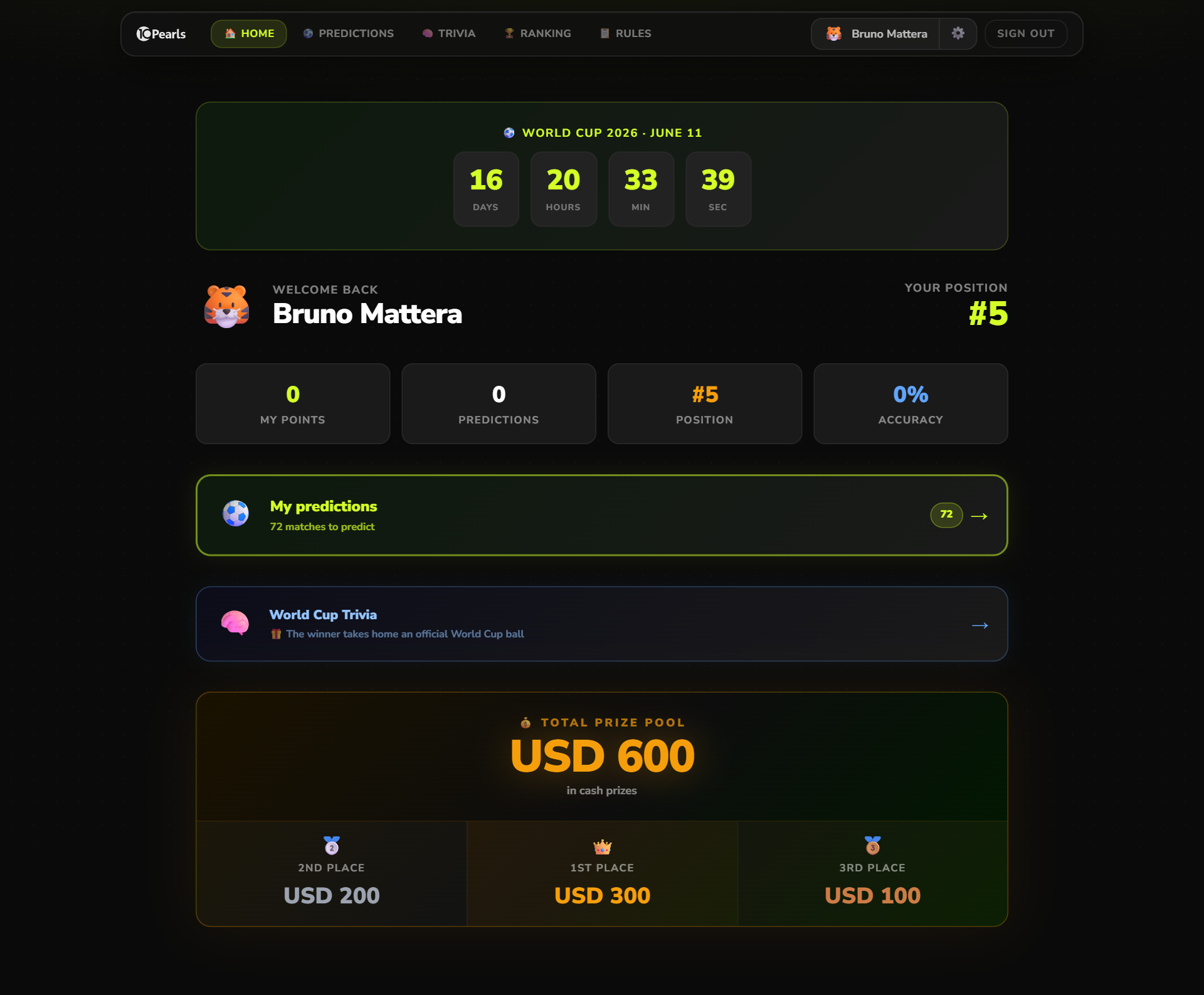
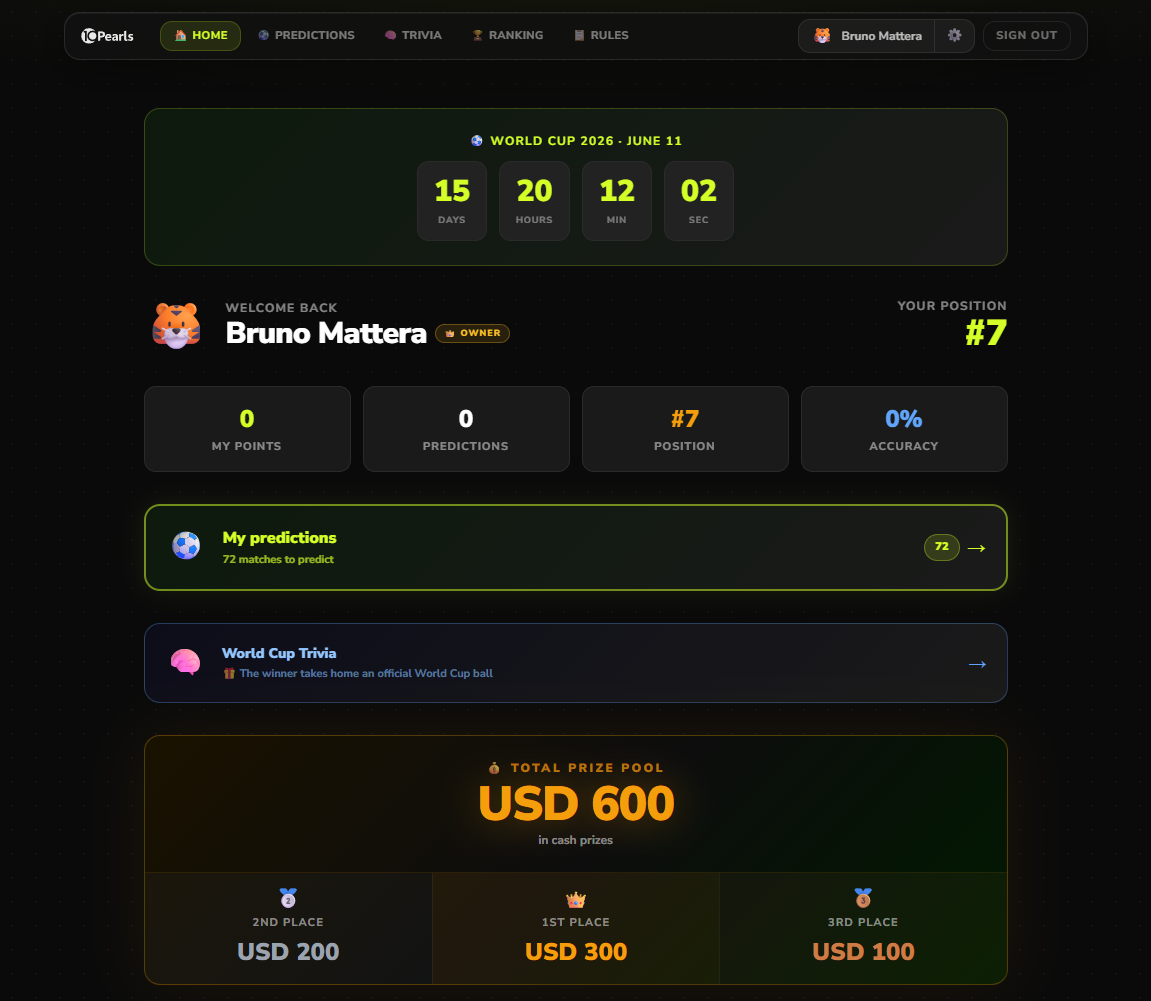
A full-stack prediction game for 10Pearls LATAM employees, built ahead of the 2026 FIFA World Cup. Designed and built solo to turn a company-wide event into an interactive, competitive experience with real stakes and a live leaderboard.
A static poll or spreadsheet wouldn't cut it. The goal was to build something people would actually open every day: check their points, track the standings, submit predictions before kickoff, and feel genuinely invested in the tournament.
Employees pick scores for every match and earn points based on accuracy. Predictions lock at kickoff; points recalculate as results come in, and the live leaderboard updates in real time.
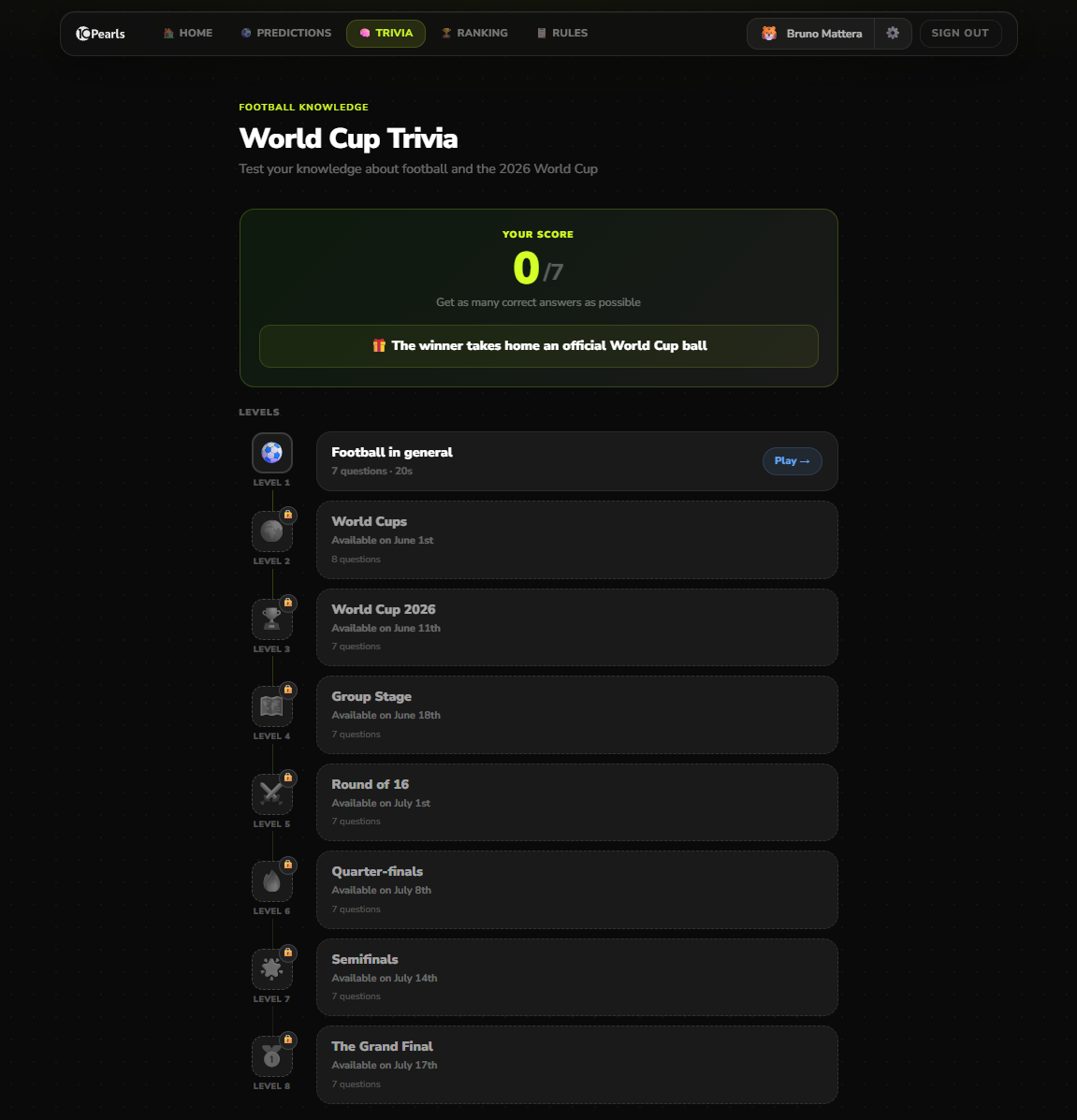
Beyond the scoreboard: players answer World Cup trivia and can see which countries their colleagues are rooting for on a shared nations wall. Two extra reasons to come back every day.
The team can load match results, manage users, sync live data from an external football API, and review a full audit log of every action taken. No manual spreadsheet maintenance.
Account recovery doesn't rely on email flows. Admins generate a one-time access link per user directly from the panel and share it through whatever channel works. Users can update their own password from their profile once logged in.
Both products followed the same four-step rhythm, designed to ship fast, with the strategy deck and the live app written by the same person, in the same week.
Why is engagement dropping? What's the friction? In KUDOS it was the blank page. In World Cup Pool it was the lack of a single place to play.
A short, opinionated deck framing the problem and the principles (Immediacy · Zero Friction · Visibility · Modeling). Used to align stakeholders before any pixel.
UX, UI, copy, and code happened in parallel. Solo, in Figma and the IDE with Claude Code as a pair, decisions made in minutes instead of weeks.
Deployed and tested live with real teammates. Small adjustments based on usage in the first week, then handed off to Marketing & Comm for ongoing operation.
Owning the strategy, the design and the build changes how you make decisions. Some patterns from this project I'm taking everywhere now.
The moment you stop calling it a "program" and start treating it as a product, the standards change. You ship something usable, not something to be managed.
Doing both yourself collapses weeks of back-and-forth into hours. I paired with Claude Code throughout (for boilerplate, refactors, i18n strings, Supabase schemas), which let me move at the speed of decisions instead of typing.
For KUDOS, AI wasn't the headline. Friction removal was. AI is the tool that makes the headline possible, not the headline itself.
Both products live where people already are, accessible from any device, no install, no onboarding. The product meets the user. Never the other way around.